NGINX [Engine x] is an HTTP Server that runs on Linux systems. It was originally written by Igor Sysoev and publicly released in 2004. This pack parses NGINX access and error logs into Graylog schema-compatible fields.
Supported Version(s)
-
NGINX 1.18
-
NGINX 1.24
Tested rsyslog Version
-
8.2212.0
Requirements
-
Graylog server with a valid Enterprise license.
-
Log delivery via Filebeat (with Graylog Sidecar) or rsyslog.
-
The pack supports a non-standard log folder as long as the file names (access.log / error.log) do not change.
Stream Configuration
This technology pack includes 1 stream:
- "Illuminate:NGINX Web Server Messages"
Index Set Configuration
This technology pack includes 1 index set definition:
- "Illuminate:NGINX_web Messages"
Log Format Examples
Access Logs
# Access log version 1.18
        127.0.0.1 - - [04/Mar/2023:19:25:07 -0600] "GET / HTTP/1.1" 200 3543 "-" "Mozilla/5.0 (X11; Ubuntu; Linux x86_64; rv:109.0) Gecko/20100101 Firefox/109.0"

        # Access log version 1.24
        127.0.0.1 - - [13/Sep/2023:08:34:54 -0500] "GET / HTTP/1.1" 200 615 "-" "Mozilla/5.0 (X11; Linux x86_64; rv:103.0) Gecko/20100101 Firefox/103.0" "-"
Error Logs
2023/03/05 09:34:46 [emerg] 2032#2032: no "ssl_certificate" is defined for the "listen ... ssl" directive in /etc/nginx/sites-enabled/default:21

        2023/01/25 11:49:34 [error] 54043#0: *1 open() "/usr/local/stefan/nginx/1.10.2_1/html/favicon.ico" failed (2: No such file or directory), client: 127.0.0.1, server: localhost, request: "GET /favicon.ico HTTP/1.1", host: "localhost:8080", referrer: "http://localhost:8080/"
What is Provided
-
Parsing rules to extract NGINX access and error logs into Graylog schema-compatible fields.
-
GIM categorization: access logs receive code 180200 (http.communication); error logs receive code 211504 (service error).
-
HTTP response code lookup mapped to NGINX-specific vendor response names.
-
Event severity lookup for NGINX error log severity levels.
-
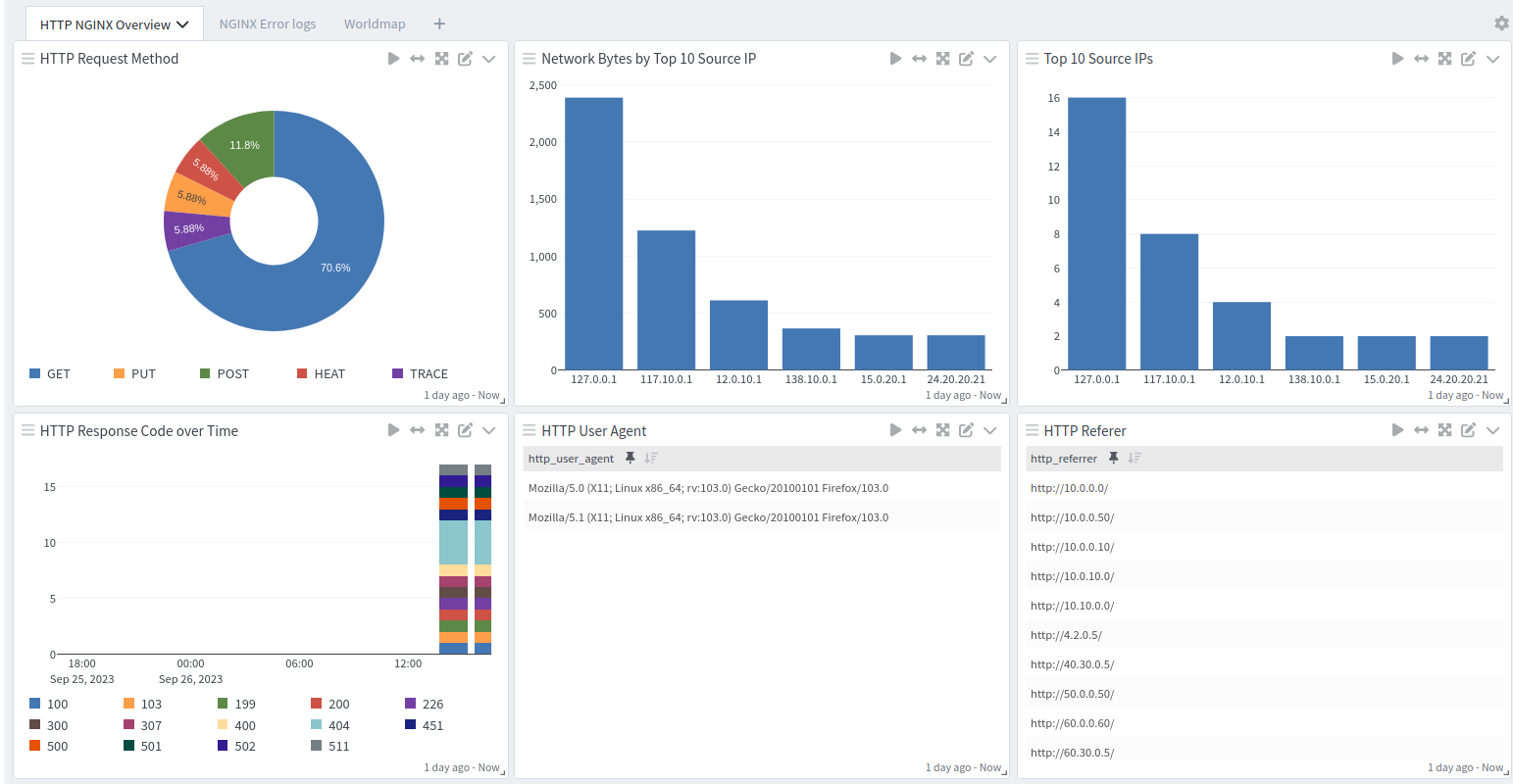
NGINX Spotlight overview dashboard.
GIM Categorization
GIM categorization is provided for the following messages:
| Log Type | gim_event_type_code | gim_event_class | gim_event_category | gim_event_subcategory | gim_event_type |
|---|---|---|---|---|---|
| HTTP Access Log | 180200 | protocol | http | http.communication | http communication |
| HTTP Error Log | 211504 | endpoint | service | service.state | service error |
Fields Extracted by This Pack
HTTP Access Log Fields
| Field Name | Description |
|---|---|
| gim_event_type_code | GIM event type code. Set to 180200 (http.communication) for all access log entries. |
| http_referrer | The referrer URL sent by the browser/client (the page that linked to this request), when present. |
| ident | Client identity value from the ident field (second field in the log line; rarely populated, typically a dash). |
| rawrequest | The full request text as logged, captured when it does not match the expected METHOD path HTTP/version format. |
| http_referrer_host | The hostname extracted from the referrer URL, when present. |
| http_request_method | The HTTP method used for the request (for example: GET, POST, PUT). |
| http_request_path | The path requested (for example: /index.html or /api/v1/items?id=1). |
| http_response_code | The HTTP status code the server returned (for example: 200, 404, 500). |
| http_user_agent | The client's User-Agent string (browser/app identifier), when present. |
| http_version | The HTTP version used in the request (for example: 1.1 or 2.0). |
| network_bytes | How many bytes were sent back in the response. |
| nginx_http_timestamp | The timestamp as recorded in the NGINX access log entry. |
| source_hostname | Client hostname making the request, when the log records a hostname instead of an IP address. |
| source_ip | Client IP address making the request. |
| user_name | Authenticated username for the request, if any. |
| vendor_http_response | NGINX-specific response description name (for example: NGX_HTTP_OK, NGX_HTTP_NOT_FOUND). |
HTTP Error Log Fields
| Field Name | Description |
|---|---|
| application_name | Set to nginx_web_http_error for all error log entries. |
| connection_id | NGINX connection number associated with the error, when present. |
| event_created | The date and time when the error log entry was written. |
| event_severity | Normalized severity level (for example: informational, low, medium, high, critical). |
| event_severity_level | Numeric severity level from 1 (debug/info) to 5 (emerg/alert/crit). |
| event_source_product | Set to nginx_web. |
| gim_event_type_code | GIM event type code. Set to 211504 (service error) for all error log entries. |
| host_ip | The host IP parsed from the error message context, when present. |
| http_referrer | The referrer URL mentioned in the error context, when present. |
| http_request_method | The HTTP method parsed from the request context in the error message, when present. |
| http_request_path | The request path parsed from the request context in the error message, when present. |
| http_version | The HTTP version parsed from the request context in the error message, when present. |
| network_protocol | The network protocol (for example: HTTP), parsed from the request context, when present. |
| process_parent_id | The NGINX master process ID (PID) that wrote the log entry. |
| process_thread_id | The NGINX worker process ID (TID) that wrote the log entry. |
| service_name | Set to NGINX_SERVICE for all error log entries. |
| source_ip | Client IP address parsed from the error message context, when present. |
| vendor_event_description | The main error message text. |
| vendor_event_severity | NGINX severity level as reported in the log (for example: emerg, alert, crit, error, warn, notice, info, debug). |
| vendor_server_hostname | The server hostname parsed from the error message context, when present (for example: localhost). |
| vendor_server_ip | The server IP parsed from the error message context, when present. |
Log Collection
Input via Filebeat together with Graylog Sidecar
Please refer to the official Graylog Sidecar documentation to configure your Graylog server and client(s).
-
Create a global Beats input in Graylog.
-
Create a Graylog REST API access token.
-
Create a (Linux) filebeat configuration under Sidecar > Configuration with a filebeat on linux collector.
-
Configure the collector with the correct Graylog server IP under
hostsand set the fieldevent_source_producttonginx-web.Copyfilebeat.inputs:
- input_type: log
paths:
- /var/log/nginx/access.log
- /var/log/nginx/error.log
type: filestream
fields_under_root: true
fields:
event_source_product: nginx-web -
Save the configuration.
-
Install Graylog Sidecar on the client host and configure it with your Graylog server URL and API token.
-
Assign the configuration to your host in Graylog Sidecar.
Input via rsyslog
Requires a configured UDP or TCP syslog input in Graylog and rsyslog installed on the NGINX host.
-
Install rsyslog via the official documentation.
-
In
/etc/rsyslog.conf, add or modify the MODULES section to enable UDP reception and forward to Graylog:Copy# provides UDP syslog reception
$ModLoad imudp
$UDPServerRun 1544
*.* @192.168.122.40:1544;RSYSLOG_SyslogProtocol23Format -
Add the following imfile configuration to forward NGINX log files to Graylog:
Copymodule(load="imfile" PollingInterval="10"
statefile.directory="/var/spool/rsyslog")
input(type="imfile"
File="/var/log/nginx/access.log"
Tag="nginx_web_http_access"
Severity="info"
Facility="local6")
input(type="imfile"
File="/var/log/nginx/error.log"
Tag="nginx_web_http_error"
Severity="info"
Facility="local6")
local6.access @192.168.122.40:1544 -
Restart the rsyslog service:
sudo systemctl restart rsyslog
NGINX Web Server Spotlight Content Pack
The NGINX spotlight offers a dashboard with 1 tab:
Overview